
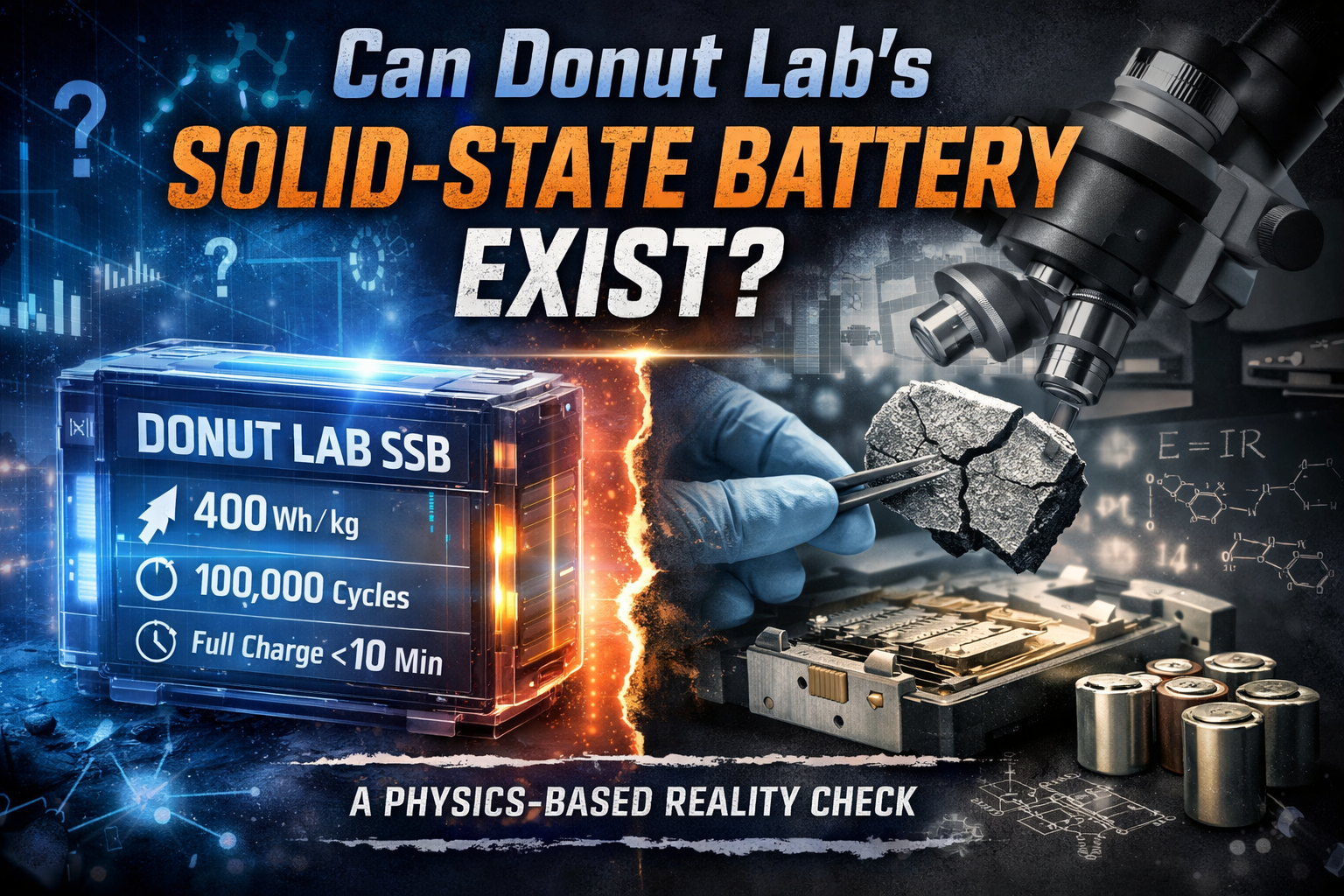
Earlier this year, Donut Lab generated significant attention by unveiling what it described as the world’s first production-ready solid-state battery. The specifications presented were extraordinary, claiming to simultaneously solve nearly every known limitation of modern batteries.
Following its public demonstration at CES 2026, however, engineers, researchers, and battery specialists began raising serious concerns about whether such a battery is chemically, physically, or economically feasible.
After reviewing Donut Lab’s public claims alongside established battery science and current research trajectories, several inconsistencies become apparent.
The Claimed Specifications
According to Donut Lab, the battery achieves:
- Full charge in under 10 minutes
- ~400 Wh/kg gravimetric energy density
- 100,000 charge cycles
- Extremely high safety
- Low cost and mass-manufacturability
- No lithium usage
- Not capacitor-based
Individually, some of these metrics exist in isolation across different technologies. Together, they do not.
Why These Claims Conflict with Known Science
1. Energy Density vs Cycle Life
High energy density batteries rely on highly reactive electrode systems, which inherently degrade faster.
A cycle life of 100,000 cycles is typically associated with capacitors or lithium-titanate systems, both of which have much lower energy density.
No known electrochemical system delivers both 400 Wh/kg and 100k cycles.
2. Fast Charging vs Safety
Sub-10-minute charging requires very high ionic conductivity and charge transfer rates.
This introduces:
- Severe heat generation
- Lithium plating or dendrite growth (even in solid electrolytes)
- Mechanical stress and interfacial breakdown
Solid electrolytes reduce flammability, but they do not eliminate failure modes.
3. The Carbon Nanotube Supercapacitor Hypothesis
One hypothesis explored by independent reviewers involved carbon nanotube-based supercapacitors, which can exhibit material-level energy densities above 400 Wh/kg.
However:
- This figure applies only to active material, not a packaged cell
- Real-world device energy density falls closer to 40–60 Wh/kg
Additionally, Donut Lab has explicitly stated that their battery is not capacitor-based, eliminating this option.
4. Sodium-Ion and Surface-Redox Systems
Surface-redox sodium-ion systems using titanium oxides can offer:
- Fast charging
- High cycle life
But:
- Energy density is far below lithium systems
- Donut Lab claims no lithium and no sodium-ion capacitor behavior
This again removes a plausible explanation.
5. Cost and Scalability Constraints
Even if a hypothetical chemistry existed, combining:
- Exotic materials
- Ultra-tight manufacturing tolerances
- High pressure solid interfaces
with claims of low cost and mass scalability contradicts everything learned from battery manufacturing over the past 30 years.
The Bigger Red Flag: All Boxes Ticked at Once
Battery development is defined by trade-offs:
- Energy density vs safety
- Power vs longevity
- Cost vs performance
A technology that simultaneously eliminates all trade-offs without disclosing chemistry, architecture, or validated third-party data deserves extraordinary scrutiny.
Reality Check: Where Battery Progress Actually Is
- Lithium-ion continues to improve incrementally and dominates real-world applications
- Lithium-titanate offers exceptional cycle life and safety, but at low energy density
- Sodium-ion shows promise for cost-sensitive stationary storage
- Solid-state batteries remain largely pre-commercial and application-specific
No verified system today meets Donut Lab’s combined claims.
Final Assessment
Absent a genuinely unprecedented and independently verified breakthrough, Donut Lab’s battery specifications remain incompatible with known electrochemistry, materials science, and manufacturing constraints.
This does not mean battery innovation has stalled. It means real progress is slower, harder, and bounded by physics—not marketing timelines.
The next battery revolution will arrive through validated data, peer review, and gradual deployment, not spectacle.