
On 28 February 1928, Sir Chandrasekhara Venkata Raman made a discovery that transformed modern spectroscopy — the Raman Effect.
In recognition of this breakthrough, India celebrates National Science Day every year on 28 February to honor scientific spirit, curiosity, and indigenous research excellence.
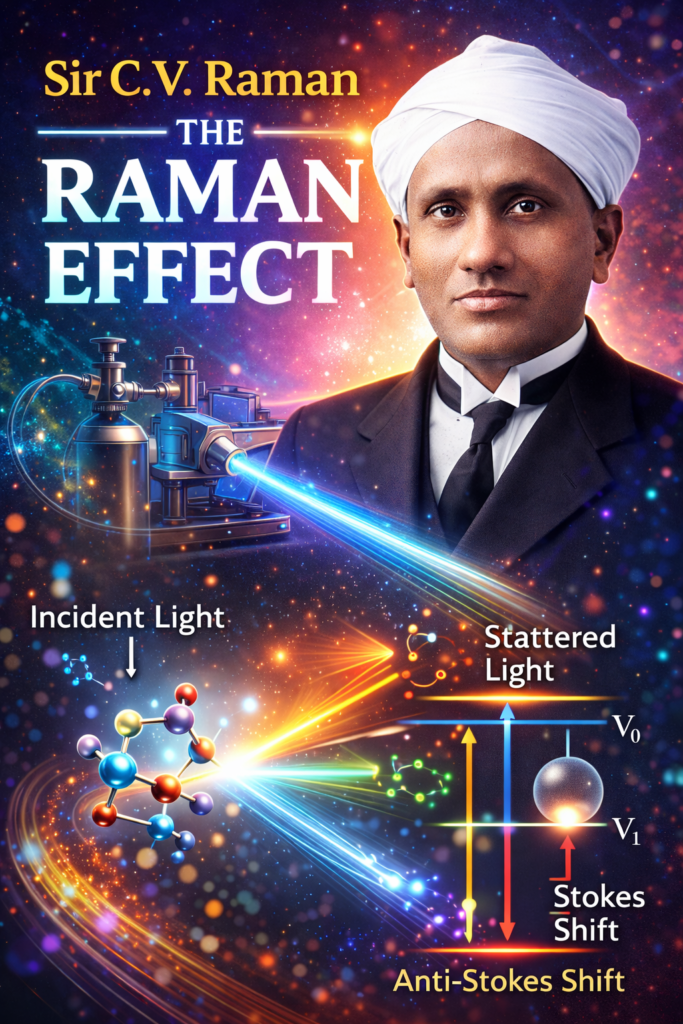
What is the Raman Effect?
The Raman Effect describes the change in wavelength of light when it interacts with matter.
When monochromatic light (single wavelength) strikes molecules:
- Most photons scatter elastically (no energy change) — known as Rayleigh scattering.
- A very small fraction scatter inelastically, meaning they exchange energy with molecular vibrational or rotational modes.
- This energy exchange shifts the wavelength of the scattered light.
- The shifted lines are called Stokes and Anti-Stokes lines.
This phenomenon provided direct experimental proof that molecular energy levels are quantized.
In essence:
Light does not merely bounce — it carries a fingerprint of the molecule it interacts with.
Why 28 February is Celebrated as National Science Day
India celebrates this day because:
- It marks a globally recognized scientific discovery made on Indian soil.
- Raman’s work earned him the Nobel Prize in Physics (1930) — the first Asian to receive a Nobel in the sciences.
- It demonstrated that world-class science can emerge from limited resources when driven by curiosity and rigor.
- It symbolizes intellectual self-reliance and scientific nationalism.
The theme of the day often focuses on innovation, sustainability, and technological progress.
Scientific Significance of the Raman Effect
Raman spectroscopy today is used in:
- Material science (crystal structure, stress analysis)
- Semiconductor characterization
- Pharmaceutical compound identification
- Biomedical diagnostics/Biophotonics
- Forensic science
- Nanotechnology
- Battery materials research (phase transitions, lithiation states)
The technique is non-destructive, requires minimal sample preparation, and provides molecular-level information.
Why This Discovery Was Extraordinary
Raman conducted his experiments with relatively simple equipment in Kolkata.
At a time when advanced laboratories were concentrated in Europe, he proved that intellectual clarity matters more than infrastructure.
He asked a simple question:
Why is the sea blue?
That curiosity led to experiments on light scattering, culminating in the discovery that changed analytical chemistry and physics forever.