
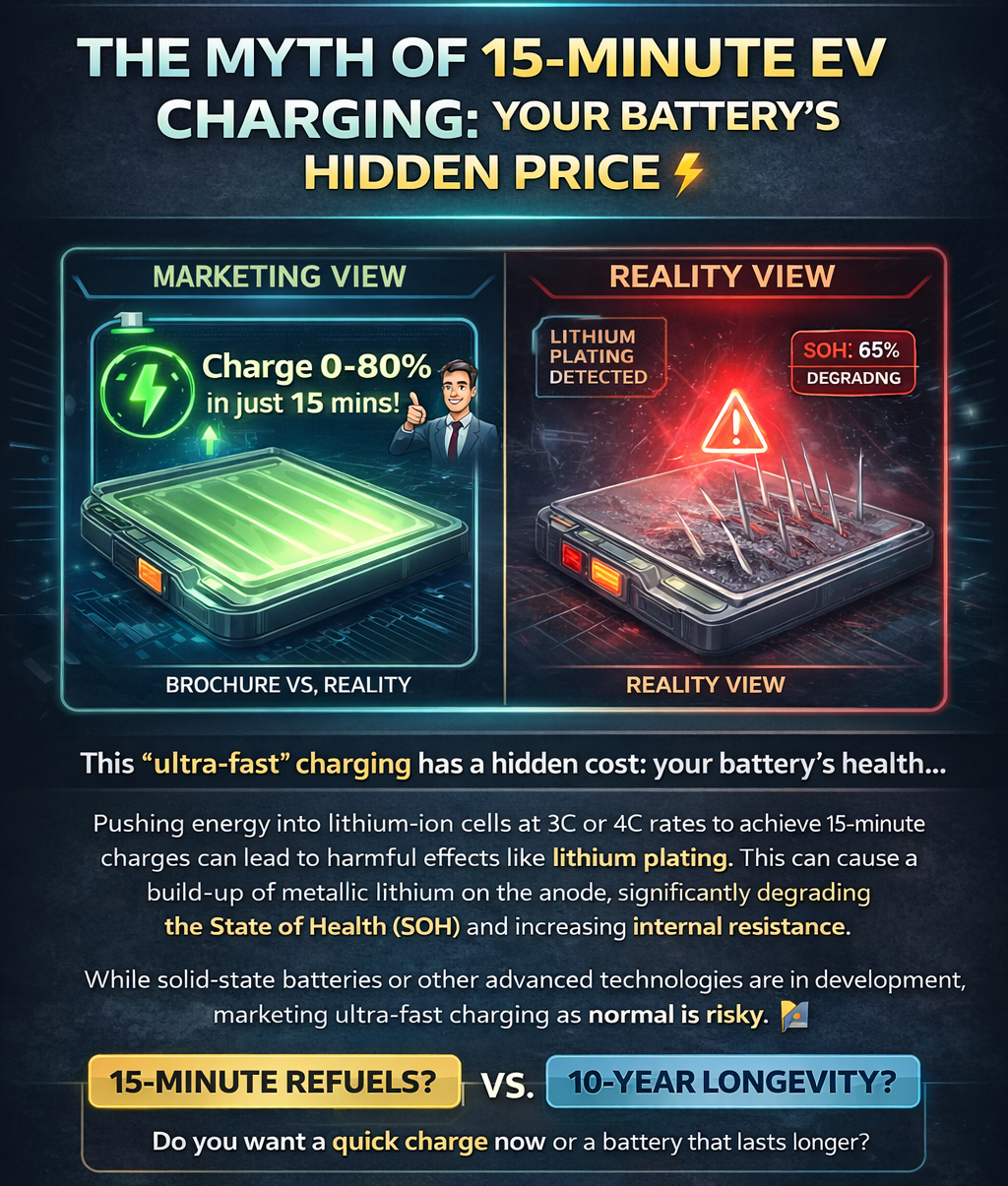
Ultra-fast charging has become the headline metric of modern EV marketing.
“0–80% in 15 minutes” sounds revolutionary—but electrochemistry tells a more nuanced story.
Lithium-ion cells are not designed to accept energy arbitrarily fast. At charge rates approaching 3C–4C, the limiting factor is no longer thermal management alone. The bottleneck is ion transport and intercalation kinetics at the anode.
When lithium ions cannot be absorbed quickly enough, they deposit as metallic lithium instead of intercalating into graphite. This phenomenon—lithium plating—irreversibly degrades the cell. It reduces usable capacity, increases internal resistance, and accelerates State-of-Health decline.
From the user’s perspective, the charge looks successful.
From the cell’s perspective, structural damage has already begun.
Until solid-state electrolytes or robust silicon-dominant anodes become commercially mature, treating ultra-fast charging as a daily behavior is technically unsound. Fast charging is a capability, not a default operating mode.
The real question is not how fast an EV can charge once—but how long its battery can remain reliable.
Short refuels or long service life. The physics forces a choice.